Jago Tamlyn
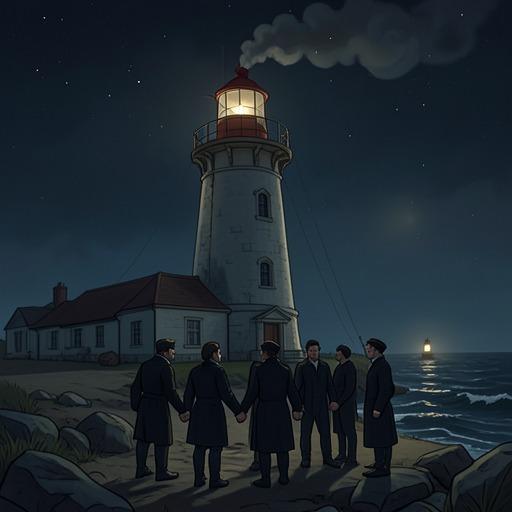
The LighthouseJago Tamlyn is Combe Island’s boatman and a central figure in the investigation of Nathan Oliver’s death. His work makes him indispensable to the island’s daily life, while his family history gives him a personal motive for revenge that reaches back across generations.
Identity and Island Role
Jago is a short, powerfully built man, under five foot six, whose stockiness is emphasized by his thick, intricately patterned dark-blue fisherman’s jersey. He wears corduroy trousers tucked into black rubber sea-boots; his long, strong-featured face, dishevelled curly hair, short beard, and sapphire-blue eyes give him a striking appearance. When he meets Adam Dalgliesh, his wary, speculative gaze shifts under the detective’s scrutiny to the passionless acquiescence of a private on a charge. The face, the narration notes, gives nothing away.
His responsibilities extend well beyond operating the launch. Jago is the island’s waterman, a qualified electrician, and the person who maintains the generator, whose failure would leave Combe Island without light or power and cut off from the mainland. He also looks after the climbing equipment and considers the ropes his responsibility. After Nathan Oliver is found hanging, Jago explains that he wound up the rope and returned it to its hook at Rupert Maycroft’s request; he left it loosely coiled because he did not intend to use it again and believed it unsafe. Maycroft had told him not to touch the knot, which might be needed for the inquest.
The island’s harbor is part of Jago’s familiar working world. From the path above it, Maycroft can see Jago’s neat cottage, with large terra-cotta pots in which Jago plans to plant summer geraniums, alongside the coiled ropes and spotless bollards. The contrast between this ordered harbor and the restless sea beyond its entrance reflects the practical responsibilities of Jago’s life: he maintains the equipment and connections that allow the island to function, even as his own history remains guarded.
Family History and Revenge
Jago’s guarded manner conceals a history in which violence is not an abstraction but an inheritance. His grandfather, Tom Tamlyn, went to sea with Saul Oliver during the wartime episode in which three German soldiers died on Combe Island and their bodies and boat were disposed of at sea. Emily Holcombe told Adam Dalgliesh that Saul had taken his young son Nathan with him; after Saul and Tom returned to the island, Tom went back out with Saul and the child. Tom never reached shore. His body was found six weeks later, and the back of his skull had been smashed. Saul said the injury came from an accident, and the coroner returned an open verdict, but the Tamlyn family believed Saul had murdered Tom to conceal the soldiers’ deaths.
Jago says he was about eleven when he first heard the story. He has never treated the absence of proof as a reason to doubt it: Nathan Oliver’s father, in his view, killed his grandfather, and the story remained known in Pentworthy among the few people still living who remembered it. Jago acknowledges that this gave him a motive to kill Nathan, one he had carried for nearly twenty-three years. Yet he distinguishes motive from method. He says he would not have hanged Oliver, and that the launch had offered him opportunities to make him fall overboard; he also points out that choosing a moment when the island was nearly empty would not fit his supposed purpose. His candour makes him a plausible suspect while giving Dalgliesh details with which to assess the limits of that suspicion.
The violence in Jago’s family history is closer still in the death of his sister Debbie. Six years earlier, after she was raped, she hanged herself. Jago rejects the softer description of her experience as seduction, and admits that he took revenge on the man responsible. The attack earned him a twelve-month sentence for grievous bodily harm; he put the man in hospital for three weeks, and the resulting local publicity damaged the man’s garage business and contributed to his wife leaving him. Jago says he could not bring Debbie back, but could make her assailant pay. His 1998 conviction, the only criminal conviction among Combe Island’s residents, therefore records both a serious assault and the retaliatory act he openly connects to his sister’s death.
That same history helps explain why Jago took pity on Millie Tranter when he found her begging in Pentworthy. He asked Rupert Maycroft to give her a room and work on the island rather than leave her to the alternative of police intervention. The parallel is not exact: Millie is not his sister, and the evidence does not make him her guardian. But his concern for a vulnerable young woman, whom he may have felt resembled Debbie, shows a protective impulse alongside the vengeance that has shaped his account of both family tragedies.
Witness, Suspect, and the Investigation
Jago is present at two sharply different moments surrounding Nathan Oliver’s death. Earlier, Rupert Maycroft comes down to the quay to find Oliver rigid with fury, Jago occupied with unloading, and Dan Padgett pressed against the cabin wall, as though awaiting judgment. The scene does not explain the dispute, but places Jago within the island’s tense working life, where the launch connects residents and visitors and where conflict can gather in full view of the harbour.
When the mist lifts at the lighthouse and Oliver’s hanging body becomes visible, Jago is beside Millie Tranter. She stares upward and screams continuously; Jago, like the others who arrive with the search party, is caught in the first confused response to the discovery. His presence makes him a witness to the moment the death becomes undeniable, not merely a suspect whose history must later be examined.
During questioning, Jago gives his account of the search and of the aftermath at the lighthouse without apparent hesitation. He explains that he returned the climbing rope to its hook at Maycroft’s instruction, and that the rope had been different from the others because he did not expect to use it again. Later, when Kate Miskin tests his account of Oliver’s time of death, Jago says he had taken the launch about half a mile out to sea to test its engine. The precise distance and task turn his practical command of the island’s boat into a point the investigation must assess against the estimated time of death.
His interview also shows the tension between suspicion and candour. Jago does not try to make himself appear innocent by denying the history that makes him suspect; instead, he gives the investigators a specific alternative to the hanging, grounded in his familiarity with the launch and the sea. His guarded appearance and his acknowledged motive leave room for suspicion, while the method he describes and the timing he supplies give Dalgliesh material to test. In this way Jago’s practical knowledge is both a source of vulnerability and part of the evidence through which the investigation distinguishes a motive from the act itself.
Narrative Role and Unresolved History
Jago’s place in the investigation joins two kinds of evidence that do not settle into the same thing: a motive he admits and an old accusation his family has carried without proof. He is candid that he wanted revenge for Tom Tamlyn, but his account also specifies why the hanging did not match the death he imagined for Nathan Oliver: Jago could have taken Oliver out alone in the launch and let him go overboard. His stated half-mile trip to test the engine gives investigators a concrete claim to examine, while his history ensures that neither his words nor his silence can be read as neutral.
The wartime story gives this suspicion its deeper shape. Nathan Oliver’s death brings Jago face to face with the son of the man he believes killed his grandfather, but the surviving evidence about Tom’s death remains incomplete: the body was recovered weeks later with a smashed skull, and the coroner’s verdict was open. Jago’s certainty belongs to family memory and local knowledge, not a proven finding. By placing that inherited conviction beside the investigation’s demand for times, methods, and verifiable accounts, the novel makes Jago both a credible suspect and a witness to how unresolved violence can organize a life without establishing who committed a later crime.